
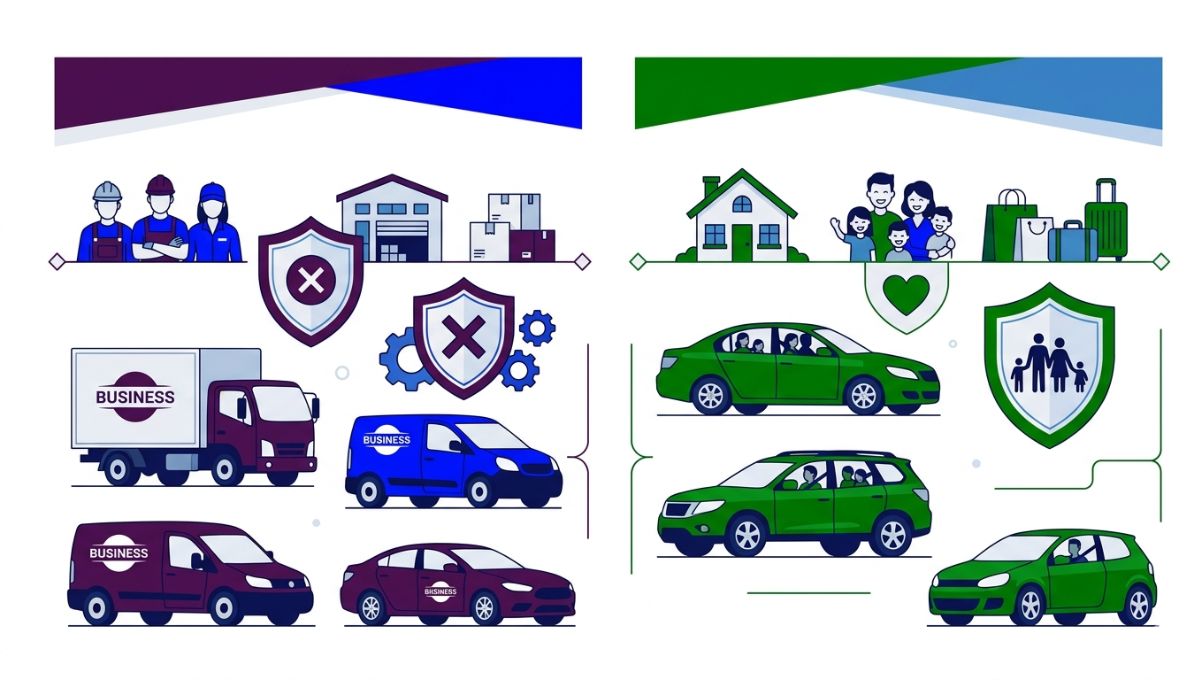
A plumbing contractor in Phoenix finishes a job, loads the van with tools, and heads to the next client site. Midway there, he rear-ends a sedan at an intersection. The other driver is injured. Property damage exceeds $40,000. The contractor files a claim under his personal auto policy, and receives a denial letter within two weeks.
The insurer’s reasoning is standard, legally sound, and devastating: the vehicle was being used for a covered business purpose at the time of loss, placing the incident squarely within the policy’s business-use exclusion. That exclusion, embedded in virtually every personal auto contract written in the United States, is the single most consequential coverage gap facing business owners today. Understanding the full weight of the commercial vs personal auto insurance 2026 distinction is no longer optional for anyone who operates a vehicle as part of running a business.
The scale of this problem has intensified heading into 2026. Insurers report more than $10 billion in net underwriting losses on commercial auto liability over the past two years, fueling ongoing rate corrections of 10 to 30 percent in many states, according to Penny Pincher’s 2026 business insurance analysis.
At the same time, the gig economy, last-mile delivery expansion, and the normalization of hybrid work models have pushed millions of vehicles into daily commercial use, often without the carriers being notified and without the correct policy in place. When those vehicles are involved in accidents, the financial exposure falls directly on the business owner. The gap between what a personal policy promises and what it actually delivers during a business-use incident is the difference between a covered claim and a six-figure personal liability judgment.
Regulatory pressure is also tightening the landscape. The Federal Motor Carrier Safety Administration launched its Motus registration platform in December 2025, with full rollout scheduled throughout 2026, modernizing how carriers file insurance and compliance documentation with federal regulators, according to FMCSA’s official filing guidance.
Separately, new rules effective January 16, 2026, imposed stricter financial responsibility requirements on brokers and freight forwarders. For business owners operating any vehicle with commercial characteristics, from a contractor’s pickup to a cargo van to a company sedan used by a sales representative, the 2026 operating environment demands a precise, informed understanding of which policy type applies, when it applies, and what happens the moment coverage does not align with actual vehicle use.
The Business-Use Exclusion: Why Personal Policies Fail Business Owners
Every standard personal auto insurance policy in the United States is priced and underwritten with a specific assumption: the vehicle is used primarily for personal activities such as commuting, running errands, and recreational driving. That underwriting assumption is not a technicality buried in fine print. It is the entire basis on which premiums are calculated and risk is accepted.
Personal auto insurance policies are underwritten based on personal risk, how someone drives for personal purposes, where they live, their personal driving record, and how many miles are put on the vehicle for non-commercial use. Insurers price those policies with the explicit assumption that the vehicle is not being used to generate income, carry business cargo, or be operated by employees. The moment a vehicle crosses into business use territory, the risk profile changes fundamentally, more miles driven, more driver variability, higher liability exposure, greater cargo value at risk, and more complex claims scenarios.
Insurers look beyond a job title to the specific intent of the trip. If an accident occurs while performing a task that benefits a business, the carrier may cite the following as grounds for claim denial if the vehicle is not properly rated for business use: job-to-job travel between multiple sites, transporting tools and inventory, and towing for a fee. These triggers apply even when the vehicle is personally owned and titled in the individual’s name.
The real danger lies in the gray area. A business owner driving from home to a regular office location, one fixed destination, may be covered under a personal policy’s standard commuting provisions. But the same driver stopping at a supply warehouse, dropping materials at a job site, or visiting a client before returning to the office has entered commercial-use territory. Most personal insurers explicitly exclude business use from their contracts. If an accident occurs while working, a claim could be denied instantly.
When the LLC Changes Everything
Business entity structure is a decisive underwriting factor that many small business owners overlook entirely. Attempting to insure an LLC-owned vehicle with a personal policy results in coverage denial. The business entity distinction changes the risk calculation and coverage structure. Any vehicle owned, leased, or registered to the business entity needs commercial coverage. This applies even if only one person drives the vehicle or uses it primarily for commuting. The critical factor is vehicle titling, moving a personally-owned vehicle to LLC ownership triggers the commercial insurance requirement.
Sole proprietors retain somewhat more flexibility. A vehicle titled in the individual’s personal name and used occasionally for business may qualify for a business-use endorsement added to a personal policy, a solution that typically costs between $10 and $40 per month according to Penny Pincher’s 2026 coverage guide. However, that endorsement has limits. Extensive business use, high-mileage commercial operations, vehicle modifications, or high-risk activities can void the endorsement’s effectiveness and still result in claim denial.
Commercial vs Personal Auto Insurance 2026: A Complete Comparison Matrix
The table below represents the definitive side-by-side breakdown of how these two policy types compare across every dimension that materially affects a business owner’s coverage and risk exposure.
| Coverage Dimension | Personal Auto Insurance | Commercial Auto Insurance |
|---|---|---|
| Primary Purpose | Personal commuting, errands, recreation | Business operations, revenue-generating trips |
| Named Insured | Individual (person’s name) | Business entity or individual operating commercially |
| Liability Limits | Typically $25,000–$100,000 CSL | $500,000–$2,000,000+ CSL (contract-driven) |
| Business Use | Excluded (standard language) | Covered as the core policy purpose |
| Vehicle Types | Personal passenger vehicles | Cars, vans, trucks, specialty vehicles, fleets |
| Employee Drivers | Not covered | Can be scheduled and covered |
| Additional Insured | Not available | Standard feature for client contracts |
| Vehicle Modifications | Not covered (ladder racks, tool boxes) | Covered as scheduled commercial equipment |
| Cargo / Equipment | Excluded | Available as endorsement or separate cargo policy |
| Average Monthly Cost | $125–$175 (single vehicle) | $147–$426+ depending on industry |
| FMCSA Filing Capable | No | Yes (BMC-91/BMC-91X for regulated carriers) |
| DOT Compliance Support | No | Yes (for interstate motor carriers) |
| Multi-Driver Scheduling | No | Yes |
| Non-Owned Auto Coverage | No | Available as HNOA endorsement |
Sources: Penny Pincher 2026, Casey Insurance 2026, FMCSA
Real Claim Denial Scenarios Business Owners Face in 2026
Understanding the theoretical distinction between policy types matters far less than recognizing exactly which real-world situations trigger a denial. The following scenarios represent the most common claim denial patterns reported in 2026, drawn from industry sources and carrier underwriting guidance.
Scenario 1: The Delivery Driver Who Was “Just Helping Out”
A restaurant owner asks a part-time employee to take the owner’s personal vehicle and deliver a catering order to a corporate client. The employee is involved in a rear-end collision on the way. The vehicle is insured under the owner’s personal auto policy. The insurer investigates, determines the vehicle was being used to transport goods for a fee at the time of the accident, and denies the claim under the commercial use exclusion. The restaurant owner faces the property damage claim and the injured third party’s medical expenses without any insurance support. Many businesses start small, often from home, and use the same vehicle for everything. If a car is being driven for work, and a personal auto policy excludes that, the risk is any accident claim being denied.
Scenario 2: The Sales Rep Using a Personal Vehicle
A technology company allows its sales team to use personal vehicles for client visits and reimburses mileage. No employer non-owned auto coverage is in place. A sales representative causes an accident while driving to a client meeting. The representative’s personal auto insurer pays up to policy limits, but those limits are exhausted by medical costs and the third party sues the employer directly. Some employees may carry only the minimum insurance coverage required by the state. If the damages from an accident exceed these minimum limits, the business might be held liable for the remaining costs. The business has no HNOA coverage and no commercial auto policy, leaving the employer fully exposed.
Scenario 3: The Contractor’s Modified Pickup
A general contractor owns a pickup truck personally but has added a ladder rack and permanent tool storage. The truck is used exclusively for job sites. He carries personal auto insurance. After a collision, his insurer investigates the modification, determines the vehicle has been permanently altered for commercial purposes, and denies the claim. Owning vehicles with permanent commercial modifications, such as ladder racks, tool boxes, and welding tanks, requires a commercial policy. The modification alone is sufficient grounds for denial regardless of how the owner classified the vehicle.
Scenario 4: The LLC-Owned Vehicle with Personal Insurance
A sole member LLC purchases a cargo van, registers it under the business name, and insures it under a personal auto policy because the owner drives it primarily for personal use on weekends. An accident occurs during a weekend trip. The insurer discovers the vehicle is titled to an LLC. The claim is denied because the named insured on the policy does not match the registered vehicle owner, and commercial vehicle titling voids personal coverage as a matter of standard underwriting practice.
The HNOA Gap: When Employees Drive Their Own Cars for Business
One of the most underinsured exposures in small and mid-size business operations today is the employer non-owned auto liability gap. Millions of businesses have employees, from administrative staff making bank runs to sales professionals driving to client sites, who use their personal vehicles for business tasks without the employer carrying any coverage for those activities.
The coverage gap works this way: commercial auto covers vehicles the business owns; general liability excludes auto accidents; personal auto excludes business use. HNOA closes all three gaps, covering business liability when vehicles the business does not own are used for business purposes.
Hired and Non-Owned Auto (HNOA) coverage fills this specific gap and is available either as a standalone endorsement or as an add-on to a Business Owner’s Policy or commercial auto policy. Hired coverage means the business has coverage when owners or employees drive a rented, leased, or borrowed car for business. Non-owned auto coverage applies to employees using their own cars for business and provides extra coverage over the employee’s personal auto policy for bodily injury and property damage liability coverage.
HNOA typically acts as excess coverage for non-owned vehicles: the employee’s personal auto policy responds first, and HNOA steps in when that policy’s limit is exhausted or when the personal insurer denies the claim due to business use exclusion.
For businesses with employees regularly driving personal vehicles for work, HNOA is one of the most cost-effective coverage additions available. It is generally added as an endorsement to an existing commercial or general liability policy rather than purchased as a standalone product, keeping costs manageable even for small businesses. For reference on how auto coverage gaps interact with broader business insurance exposures, the personal vs commercial auto insurance overview on QuoteMonster provides a useful foundational comparison.
2026 Rate and Regulatory Landscape: What Has Changed
FMCSA’s Motus Platform and the New Filing Environment
The most significant infrastructure change affecting commercial auto compliance in 2026 is the FMCSA’s rollout of Motus, its new registration and insurance filing platform. FMCSA’s new registration platform, called Motus, underwent limited launch in December 2025 and will expand significantly throughout 2026. The system promises to replace the decades-old registration infrastructure with a modern, mobile-compatible platform. All insurance filings, including BMC-91 and BMC-91X forms required for motor carrier authority, are migrating to Motus. Carriers who fail to “claim” their existing Licensing and Insurance accounts within the new system risk losing active filing status, which can trigger operating authority revocation.
Effective January 16, 2026, brokers, freight forwarders, and financial responsibility providers must comply with new rules regarding broker/freight forwarder financial responsibility. For businesses in the freight and logistics supply chain, this means insurance documentation must be updated to reflect the new compliance structure or contract relationships with brokers and shippers may be disrupted.
FMCSA Minimum Liability Requirements (2026)
The federal minimums established under 49 CFR Part 387 remain in force for regulated carriers in 2026. For nonhazardous cargo in smaller vehicles, minimum coverage is $300,000. For hazardous cargo, minimum coverage is $5,000,000. For nonhazardous cargo in larger operations, minimum coverage is $750,000. These are floor-level requirements. Most commercial contracts and broker relationships require at least $1,000,000 in combined single limit (CSL) auto liability, making state and federal minimums inadequate for most operating scenarios.
| Operation Type | FMCSA Minimum Liability | Typical Contract Requirement |
|---|---|---|
| Small vehicles, nonhazardous cargo | $300,000 | $500,000–$1,000,000 |
| Large vehicles, nonhazardous cargo | $750,000 | $1,000,000+ |
| Hazardous materials | $5,000,000 | $5,000,000 |
| Oil/non-classified substances | $1,000,000 | $1,000,000 |
Source: Progressive Commercial FMCSA Requirements
2026 Commercial Auto Premium Benchmarks by Industry
Commercial auto insurance typically costs 10 to 30 percent more than comparable personal coverage. Average monthly costs start around $147 to $160 for a single standard-use business vehicle, but climb significantly by industry, contractors average $215 to $272 monthly, cargo vans around $426, and transportation and trucking businesses $954 to $1,125 per month.
| Business Type | Avg. Monthly Premium (2026) | Key Risk Factor |
|---|---|---|
| Single standard business vehicle | $147–$160 | General business use, limited mileage |
| Contractor / trades | $215–$272 | Multiple job sites, tool transport |
| Cargo van operations | ~$426 | High mileage, delivery frequency |
| Taxi / limousine | ~$624 | Passenger transport, high liability |
| Trucking / transportation | $954–$1,125 | Interstate operations, cargo value |
| Heavy-duty for-hire trucks | $600–$2,500+ | Claim severity, FMCSA filings |
Sources: Penny Pincher 2026, Logrock Commercial Vehicle Insurance Rates 2026
Rate-reduction strategies in 2026 include telematics adoption, which can reduce premiums by 10 to 25 percent through demonstrated safe driving data, according to Casey Insurance’s 2026 commercial auto analysis. Bundling commercial auto with a general liability or Business Owner’s Policy through the same carrier typically yields an additional 10 to 15 percent multi-policy discount.
For businesses tracking the impact of weather events on auto insurance claims, particularly those operating in high-catastrophe states like Florida, Louisiana, and Nevada, the compounding effect of catastrophe risk on commercial premiums is a real and growing consideration.
State-Level Liability Minimum Increases
California’s commercial auto liability minimum increased to $30,000/$60,000/$15,000 under SB 1107 effective January 1, 2025, according to Logrock’s California commercial auto compliance guide, with another scheduled increase targeted for 2035. While these are the statutory floor levels, most commercial contracts, MCP requirements, and broker relationships in California require $1,000,000 CSL. Business owners operating in California must verify that their policy limits match the requirement tier applicable to their vehicle classification, operating authority, and contractual obligations, not just the state minimum.
Coverage Decision Matrix: Which Policy Does a Business Owner Actually Need?
The decision framework below is designed to help business owners identify their coverage requirement tier based on vehicle use, ownership structure, and operational profile. This is an informational guide and not a substitute for consultation with a licensed commercial insurance advisor.
| Business Scenario | Recommended Coverage |
|---|---|
| Commuting to one fixed office, personal vehicle, personally titled | Personal auto (commuting class) |
| Occasional business errands, personal vehicle, sole proprietor | Business-use endorsement on personal policy |
| Regular client visits, personal vehicle, LLC or corporation | HNOA + confirm commercial classification |
| Delivery driving, personal vehicle | Commercial auto or rideshare/delivery endorsement (if available) |
| Company-owned vehicle, any employee driver | Commercial auto policy required |
| LLC-titled vehicle, any use | Commercial auto policy required |
| Fleet of 3+ vehicles | Commercial fleet policy |
| Vehicles over 10,000 lbs GVW | Commercial auto (may require FMCSA filing) |
| Interstate freight hauling | FMCSA operating authority + BMC-91 filing |
| Employees using personal cars for work | Employer Non-Owned Auto (HNOA) endorsement |
| Rented vehicles for business trips | Hired auto coverage or HNOA |
For business owners operating in multiple states or managing a mixed fleet, the QuoteMonster guide on homeowners insurance by state offers a useful parallel for understanding how state-by-state regulatory variation affects insurance requirements across lines of coverage.
DOT Compliance Factors That Affect Commercial Auto Insurance in 2026
Beyond the basic commercial vs personal policy distinction, businesses operating vehicles that meet the definition of a commercial motor vehicle under federal or state law face an additional compliance layer. Vehicles over 10,000 pounds gross vehicle weight or with a load capacity of 2,000 pounds or more require commercial insurance. These specifications bring vehicles into regulated territory that may require not just commercial auto insurance, but FMCSA filings, electronic logging device compliance, and DOT medical certification for drivers.
Electronic Logging Devices remain mandatory for most commercial motor vehicles, and carriers must ensure their devices maintain FMCSA certification. FMCSA also announced enhanced ELD oversight measures in 2025, including deeper technical reviews, expanded documentation requirements, and clearer frameworks for determining whether devices should remain on the approved list.
For 2026, DOT random drug and alcohol testing rates are expected to remain at 50 percent for drug tests and 10 percent for alcohol tests for FMCSA-regulated employers, according to DISA’s 2026 DOT compliance update. Carriers must ensure all CDL drivers participate in a compliant random drug testing program. Non-compliance with any of these requirements can directly affect a carrier’s ability to maintain insurance filings with FMCSA, which in turn affects operating authority and the ability to legally haul freight.
Understanding how DOT compliance intersects with insurance underwriting matters because insurers increasingly use DOT safety scores, CSA data, and ELD records as underwriting inputs. A carrier with safety violations will pay significantly higher premiums than a clean-record operation with identical vehicle types and mileage. A clean Motor Vehicle Record and no recent claims can reduce costs by 20 to 40 percent.
Business Auto Endorsements: The Middle-Ground Solutions
Not every business vehicle scenario requires a full commercial auto policy. The insurance industry offers several endorsements and hybrid coverage solutions designed to address common business use scenarios without the full premium load of a standalone commercial policy. Understanding these options helps business owners avoid both underinsurance and unnecessary overspending.
Business-Use Endorsement
Added to a personal auto policy, this endorsement extends coverage to include regular business driving such as client visits and sales calls. It does not cover commercial delivery, cargo transport, or employee drivers. Cost typically ranges from $10 to $40 per month. Appropriate only for sole proprietors with personally titled vehicles and limited, low-risk business driving.
Named Non-Owner Policy
Covers an individual who regularly drives vehicles they do not own for business purposes. Common for sales professionals, consultants, and contractors who rely entirely on rented or borrowed vehicles and have no personally owned vehicle to insure.
HNOA Endorsement
Added to a commercial auto or general liability policy, this covers liability arising from employee use of personal vehicles and from rented or hired vehicles. It does not cover physical damage to the non-owned vehicle itself.
Rideshare / Transportation Network Endorsement
Specific to drivers participating in TNC platforms (Uber, Lyft, DoorDash, etc.), this endorsement fills the gap period between personal use and active TNC app coverage. Standard personal policies exclude TNC driving entirely. As noted in QuoteMonster’s personal vs commercial auto insurance content, rideshare endorsements are now available from most major carriers but must be added proactively before an incident occurs.
Commercial Auto Fleet Policy
For businesses operating three or more vehicles, a fleet policy consolidates coverage under a single contract with a combined limit, streamlined driver scheduling, and fleet-level pricing. Fleet policies typically require a loss run history and driver qualification records at binding.
Conclusion
The distinction between commercial and personal auto insurance has never carried higher financial stakes than it does in 2026. The combination of sustained commercial auto rate increases, more rigorous FMCSA compliance infrastructure through the Motus platform, growing gig economy vehicle use, and increasingly aggressive claim investigation by insurers has created an environment in which coverage misclassification is both more likely to occur and more costly when it does.
For business owners, the central lesson is straightforward but frequently ignored: the nature of a vehicle’s use, not its appearance or the personal identity of its driver, determines which policy applies. A personal sedan driven by a business owner to client meetings is a commercial vehicle from the insurer’s perspective the moment it crosses from personal errand into business-purpose use. An LLC-titled van is a commercial vehicle regardless of how rarely it makes deliveries. The business-use exclusion does not care about intent, familiarity, or the informal understanding between an employer and an employee. It activates mechanically, and it activates at the worst possible moment, after an accident has already occurred.
The practical steps available to business owners are clear. Auditing every vehicle that touches business operations, owned, employee-owned, rented, borrowed, and confirming that each has appropriate coverage is the foundational action. For owned business vehicles, a commercial auto policy is not optional. For scenarios involving employee personal vehicles used for work tasks, an HNOA endorsement fills the gap that commercial auto, personal auto, and general liability all leave open simultaneously. For businesses with DOT-regulated vehicles, confirming FMCSA filing status, ELD compliance, and accurate insurance filings in the new Motus system is an urgent 2026 priority.
The broader implication for the insurance market is that 2026 represents an inflection point. Social inflation, the trend of jury awards and settlements far exceeding actual damages, continues to push commercial auto liability claim costs upward. Insurers are responding with tighter underwriting, more thorough claim investigation, and higher premiums for operations that present elevated risk. Business owners who treat commercial auto coverage as a discretionary expense are effectively self-insuring against losses that can reach seven figures in a single serious accident. Comparing quotes from multiple commercial auto carriers, reviewing policy language carefully, and consulting a licensed commercial lines advisor are not bureaucratic exercises. They are the practical tools that keep a business financially viable when the unexpected happens on the road.
Frequently Asked Questions
1. What is the main difference between commercial and personal auto insurance in 2026?
The core distinction is vehicle use and purpose. Personal auto insurance covers vehicles used for everyday activities like commuting, errands, and recreation. Commercial auto insurance covers vehicles used to generate income, carry business cargo, transport clients, or be operated by employees as part of business operations. In 2026, this distinction is enforced rigorously by insurers through the business-use exclusion found in virtually every standard personal auto policy. Consulting a licensed commercial insurance advisor is the most reliable way to determine which policy applies to a specific vehicle and use pattern.
2. Can a personal auto policy ever cover business driving?
In limited circumstances, yes. A business-use endorsement added to a personal auto policy can extend coverage to routine business driving, such as client visits and sales calls, for a sole proprietor with a personally titled vehicle. However, this endorsement does not cover commercial delivery, cargo transport, employee drivers, or LLC-titled vehicles. Any business activity beyond light occasional business driving generally requires a proper commercial auto policy or at minimum a formal HNOA endorsement. Policyholders should review their specific policy language and speak with a licensed agent before assuming any business-use activities are covered.
3. What is employer non-owned auto (HNOA) insurance and does my business need it?
Hired and Non-Owned Auto (HNOA) insurance covers a business’s liability when employees use their personal vehicles for business tasks or when the business rents vehicles for work. If any employee drives their personal car to make deliveries, pick up supplies, visit clients, or perform any work task, and the employer does not carry HNOA, the employer is potentially uninsured against the liability that arises from those accidents. Most small businesses that have employees performing any driving for work purposes should evaluate HNOA as a foundational coverage layer. Insureon’s HNOA guide provides additional detail on coverage specifics.
4. Does vehicle titling in an LLC name automatically require commercial auto insurance?
Yes. When a vehicle is titled, registered, or owned by any business entity, including an LLC, corporation, or partnership, it cannot be validly insured under a personal auto policy. The business entity’s ownership fundamentally changes the risk profile and underwriting classification. Even if only one person drives the vehicle and uses it primarily for personal activities, the LLC ownership triggers the commercial coverage requirement. Carriers who discover entity ownership at the time of a claim will deny coverage under the personal policy regardless of actual use patterns.
5. What are FMCSA insurance requirements for businesses in 2026?
The Federal Motor Carrier Safety Administration sets minimum liability requirements for regulated commercial carriers under 49 CFR Part 387. For smaller vehicles hauling nonhazardous cargo, the minimum is $300,000. For larger vehicles with nonhazardous cargo, the minimum is $750,000. Hazardous materials operations require $5,000,000 in coverage. In 2026, the FMCSA also launched the Motus platform for insurance filings, replacing legacy systems. Businesses hauling freight interstate must maintain active filings with FMCSA through this platform to preserve operating authority. More detail is available at FMCSA’s official filing page.
6. How much does commercial auto insurance cost for a small business in 2026?
Commercial auto premiums for a single standard-use business vehicle start around $147 to $160 per month in 2026, according to industry benchmarks. Costs rise significantly by industry, contractors typically pay $215 to $272 monthly, cargo van operations around $426 per month, and trucking operations $954 to $1,125 per month. Key pricing factors include vehicle type, garaging ZIP code, driver Motor Vehicle Records, claims history, annual mileage, operating radius, and liability limits selected. Telematics adoption and multi-policy bundling can reduce premiums by 10 to 25 percent in many cases. Comparing quotes across multiple commercial carriers is the most effective way to identify the best premium for a given risk profile.
7. What vehicles require commercial auto insurance regardless of business use?
Beyond the use-based triggers, certain vehicle characteristics mandate commercial coverage independent of how the vehicle is used. Vehicles exceeding 10,000 pounds gross vehicle weight, those with a load capacity of 2,000 pounds or more, and any vehicle permanently modified with commercial equipment such as ladder racks, welding tanks, or built-in tool storage generally require commercial policies. Buses, food trucks, bucket trucks, dump trucks, box trucks, cargo vans, and semi-trailer trucks are almost universally classified as commercial vehicles requiring commercial insurance regardless of ownership structure.
8. Does a personal auto policy cover rideshare or delivery driving for gig platforms?
No. Standard personal auto policies universally exclude commercial transportation network activity, which includes driving for Uber, Lyft, DoorDash, Amazon Flex, Instacart, and similar platforms. When a driver activates the platform app but has not yet accepted a ride or delivery, neither the personal policy nor the TNC’s commercial policy typically provides coverage, this gap period represents the primary risk zone. Most major carriers now offer rideshare endorsements that fill this specific gap period, but the endorsement must be added before an incident. Drivers operating through gig platforms without the appropriate endorsement or commercial policy risk claim denial for any accident occurring during platform-connected activity.
9. What is a business auto endorsement and when does it apply?
A business auto endorsement is an add-on to a personal auto policy that extends coverage to regular business-purpose driving for a sole proprietor with a personally titled vehicle. It is appropriate for situations such as routine client visits, sales meetings, and light errand-based business driving. It does not extend to delivery driving, cargo transport, use by employees, or vehicles titled to a business entity. The endorsement typically costs between $10 and $40 per month. Business owners considering this option should review the specific exclusions in their endorsement language with a licensed agent, as coverage scope varies by carrier and state.
10. How do I know if my current auto policy covers my business vehicle use?
The first step is reading the business-use exclusion language in the current personal policy, it will typically appear in the definitions section or exclusions section of the declarations. Key red flags include language such as “vehicles used for carrying persons or property for a charge,” “vehicles used in any business,” or “livery use.” The second step is disclosing all actual vehicle use, including the nature of trips, who drives the vehicle, whether the vehicle is titled to a business entity, and any physical modifications, to a licensed insurance agent. Any gap between actual use and the policy’s covered use is a denial waiting to happen. Business owners can use neutral quote-comparison tools to review commercial auto options and find appropriate coverage across multiple carriers.
Sources and References
- Casey Insurance: Commercial Auto vs Personal Auto 2026
- Penny Pincher: Business Car Insurance 2026
- FMCSA: Insurance Filing Requirements
- DISA: 2026 DOT Compliance Updates for Motor Carriers
- Construction Coverage: Commercial vs Personal Auto for Contractors
- ISU ARMAC: Can Commercial Vehicles Buy Personal Insurance
- Progressive Commercial: FMCSA Insurance Requirements
- Casey Insurance: Hired and Non-Owned Auto Insurance
- Logrock: Commercial Vehicle Insurance Rates 2026
- Logrock: California Commercial Auto Requirements 2026
- First Advantage: Navigating 2026 Compliance Changes
- Insureon: Hired and Non-Owned Auto Insurance
- Cheap Insurance: Commercial vs Personal Auto
- Pro Insurance Group: Commercial Truck Insurance 2026
- GEICO: Commercial vs Personal Auto Insurance